Executive Summary
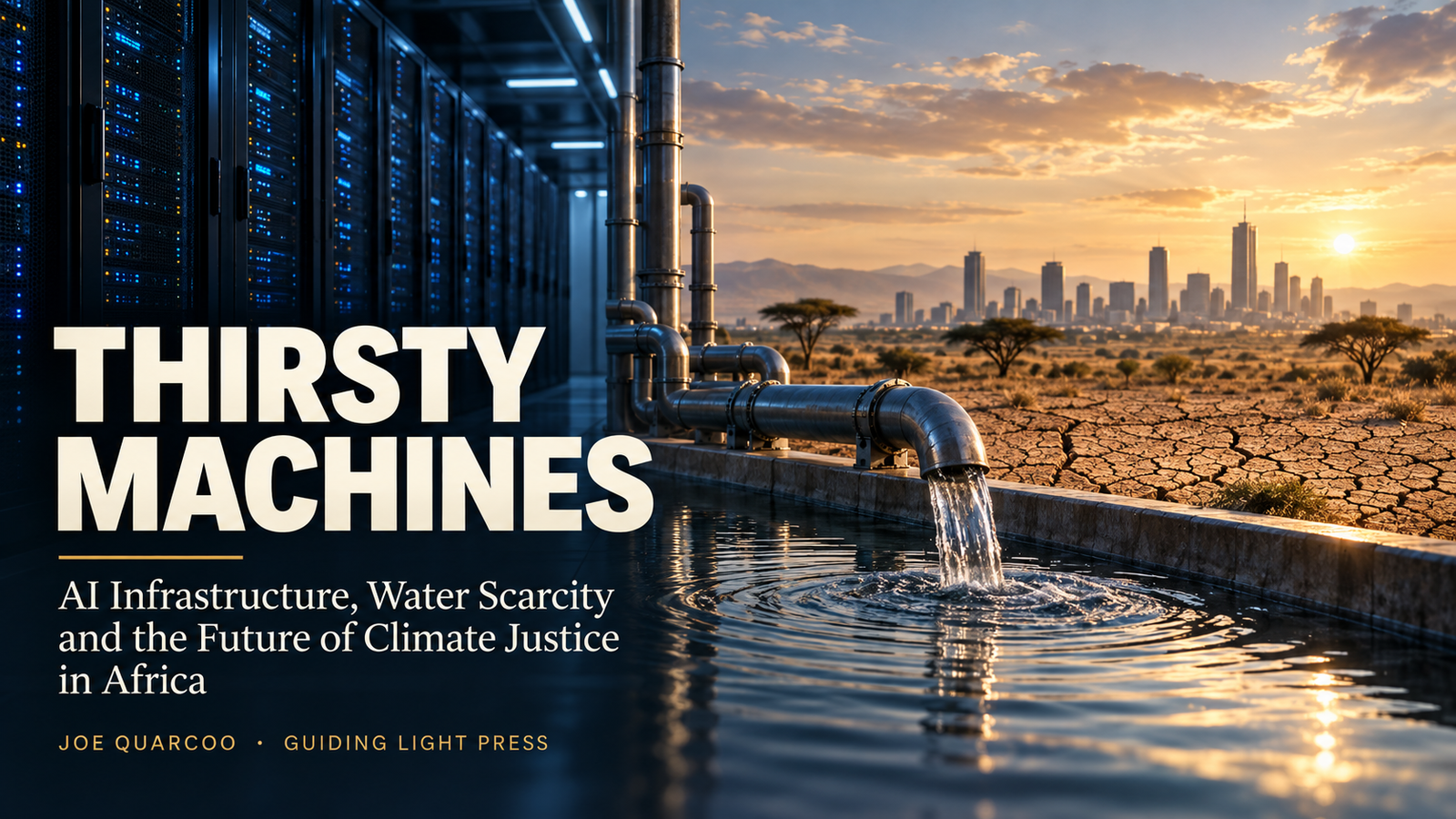
Artificial intelligence is often presented as a digital revolution, yet its infrastructure is profoundly material. Beneath the abstraction of “the cloud” sits a rapidly expanding network of data centres: buildings filled with servers that consume electricity, generate heat and must be cooled continuously. Across Africa, where climate change is intensifying pressure on water, electricity and public infrastructure, the expansion of AI-ready facilities introduces a critical and under-examined tension.
The issue is not that every data centre consumes the same quantity of water, or that every cooling system works in the same way. Water use varies by climate, facility design, workload, energy source and cooling technology. The policy concern is that decisions about location, disclosure and resource allocation can place global digital demand in direct competition with local ecological limits.
This article places Africa within a wider Global South landscape spanning Latin America and Asia. It argues that African countries need not reject digital infrastructure. They can instead insist that it is planned transparently, governed in the public interest and designed around water security, clean energy, community participation and long-term resilience.
A digital revolution with a physical footprint
Artificial intelligence depends on computation at a scale that is easy to overlook when people interact with a chatbot, generate an image or use a cloud service. Training and operating advanced models requires dense clusters of processors, storage equipment, networking hardware and backup systems. Every calculation produces heat. If that heat is not removed, performance falls and equipment can fail.
Data centres therefore rely on cooling systems. Some primarily use air. Others use chilled-water systems, evaporative cooling, direct-to-chip liquid cooling or combinations of these approaches. Liquid cooling can transfer heat more efficiently from high-density equipment, but the presence of liquid near a processor does not by itself reveal how much freshwater a whole facility consumes. The decisive question is how heat is ultimately rejected, whether water is recirculated, what quality of water is used and how local climate affects performance.
The distinction between water withdrawal and water consumption also matters. Withdrawal is water taken from a source and potentially returned. Consumption is the portion not returned to the same local water system, often because it evaporates or is incorporated into another process. A facility can report modest on-site consumption while still carrying a significant indirect water footprint through the electricity used to power it. Thermal power generation, for example, may itself withdraw and consume water.
This is why single, universal claims about how many litres “a data centre” uses each day can mislead. A useful assessment must identify the facility, workload, cooling design, local climate, electricity mix, reporting boundary and time period. The responsible question is not simply “does AI use water?” It is: how much water is used, of what quality, where, when, by which system, at whose expense, and with what safeguards?
Why the debate is becoming urgent
The International Energy Agency has warned that there is no AI without energy, and its 2025 analysis projects rising electricity demand from data centres as AI deployment accelerates. The World Bank and International Telecommunication Union have similarly emphasised that data centres require land and water as well as power, and that governments have a central role in establishing standards for greener, climate-resilient digital infrastructure.
Public concern is now reaching the highest levels of political and civic life. Recent UK reporting described King Charles III convening AI executives amid growing concern about the technology’s risks and its relationship to human wellbeing. That intervention should not be misrepresented as a direct royal instruction to halt or slow AI development. It does, however, reflect a broader and legitimate demand: technological progress must remain answerable to society, democratic judgment and the conditions that sustain life.
Water belongs within that conversation. The environmental cost of AI is not confined to carbon emissions. It also involves the geography of data centres, competition for water and electricity, construction impacts, waste heat, electronic waste and the distribution of both benefits and burdens.
Shared pressures across the Global South
Countries across the Global South are attractive to data-centre developers because of growing digital markets, expanding fibre connectivity, lower land and construction costs, renewable-energy potential and strategic proximity to users. Those advantages can support employment, digital sovereignty and better public services. Yet environmental pressure is not eliminated when infrastructure moves. It is often shifted geographically towards places where regulation, disclosure and public participation may be weaker.
Chile and the politics of water
Santiago has become a defining case. In Cerrillos, plans associated with a proposed Google data centre generated concern about groundwater extraction in a region affected by prolonged drought. Chile’s Second Environmental Court required climate impacts to be considered more fully in the environmental assessment. Google later said a redesigned proposal would use air cooling rather than the earlier water-based approach. The case matters because organised communities made water demand, climate risk and environmental review central to infrastructure planning before construction locked in the original design.
Singapore and resource-constrained growth
Singapore’s experience demonstrates that even a wealthy, highly capable digital hub must confront physical limits. After constraining new data-centre development, the country introduced a Green Data Centre Roadmap and sustainability standards suited to tropical conditions. Its approach connects additional capacity to improved energy efficiency, lower-carbon power and more demanding resource performance. The lesson is not that every African country should copy Singapore. It is that digital ambitions can be conditioned by explicit environmental rules rather than treated as automatically overriding them.
India and hot-climate expansion
India’s data-centre market is expanding around major hubs including Mumbai, Chennai and Hyderabad. These cities combine strong connectivity and demand with heat, water stress or both. The geography reinforces an important point: national averages are inadequate. A country may possess substantial water resources overall while a particular city, watershed or season faces acute scarcity. Approval systems must therefore use basin-level and seasonal evidence.
Africa’s geography of risk and possibility
Africa is not one environmental zone and should not be divided into simplistic lists of “safe” and “unsafe” countries. Water availability, infrastructure reliability, governance capacity and community vulnerability vary within national borders. The appropriate unit of assessment is often the city, catchment, power system and community rather than the country alone.
South Africa
South Africa has the continent’s most mature data-centre market, concentrated largely around Johannesburg and Cape Town. It also has lived through severe drought, electricity insecurity and profound spatial inequality. Cape Town’s approach to “Day Zero” showed how quickly water scarcity can dominate public life. New facilities should therefore be assessed not only against annual supply but also against drought scenarios, municipal resilience, electricity sources and the cumulative demand of other developments.
Kenya
Kenya’s digital ecosystem and undersea cable connections have strengthened Nairobi’s position as an East African technology hub. At Olkaria, geothermal power offers an opportunity to combine computing infrastructure with relatively low-carbon electricity. EcoCloud has promoted a data-centre model linked to geothermal energy. Even here, renewable power does not remove the need for transparent water accounting, responsible siting and scrutiny of local social and ecological impacts.
Ghana
Ghana’s growing digital economy and National Information Technology Agency infrastructure create opportunities to host more data and public services locally. Accra’s coastal position and regional connectivity are advantages, but households and businesses still experience uneven water and electricity services. Future expansion should not be justified by national rainfall alone. It should be aligned with municipal capacity, watershed conditions, resilient power and enforceable disclosure requirements.
Nigeria
Nigeria’s population, financial technology sector and digital demand make Lagos an important market. Yet rapid urban growth, electricity constraints, reliance on backup generation, flooding and uneven access to water complicate the sustainability picture. Efficiency claims should include the whole operating system, including generators, fuel, grid conditions and indirect water use.
North and Southern Africa
Morocco’s proximity to Europe and renewable-energy investment make it attractive, while increasing water stress makes siting and cooling choices especially consequential. Namibia and Botswana have strong solar potential but are among the world’s most water-constrained environments. Zambia, Uganda and the Democratic Republic of the Congo possess significant freshwater or hydropower resources, yet abundance at national scale does not remove governance, ecosystem, transmission or local-access challenges. “Water-rich” should never become permission for poorly governed extraction.
The water energy climate relationship
Cooling sits inside a wider water-energy-climate system. Rising temperatures increase cooling demand. Cooling and computation increase electricity demand. Where electricity is generated from fossil fuels, additional demand contributes to emissions and air pollution. Where generation is water-intensive, it also adds an indirect water footprint. Waste heat can affect the surrounding urban environment unless it is managed or beneficially reused.
The relationship can become a reinforcing loop: a warming climate increases the resources required to keep digital infrastructure operating, while poorly planned infrastructure adds further environmental pressure. Yet the loop is not inevitable. Efficient hardware, workload management, renewable power, heat reuse and climate-appropriate cooling can reduce impact. What matters is whether these options are required, measured and enforced rather than left to voluntary promises.
Why local consequences extend beyond the facility fence
Water and energy decisions create effects across social and ecological systems:
- Domestic water access can be affected when industrial demand competes with households during dry periods or infrastructure failure.
- Food security can be affected when groundwater or surface water needed for irrigation is placed under additional pressure.
- Aquatic ecosystems can be affected by water withdrawal, altered flows, discharges or thermal pollution.
- Urban inequality can deepen when communities bear environmental costs while receiving few secure jobs or affordable digital services.
- Public finances can be exposed when governments provide land, power infrastructure, tax incentives or water capacity without securing proportionate public value.
These impacts are not evenly distributed. Low-income communities, informal settlements, small farmers, women responsible for household water and people already facing unreliable services can carry a disproportionate burden. Climate justice requires that distributional effects be assessed before permits and incentives are granted.
Ownership power and digital sovereignty
The global cloud and AI infrastructure market is dominated by a relatively small number of multinational firms and large colocation providers. This creates a potential imbalance between local inputs and globally distributed value. Land, water, electricity, public incentives and environmental risk remain local. Computing services, intellectual property, data control and corporate profit can flow elsewhere.
That pattern is not unavoidable. Data centres can strengthen local resilience, improve latency, support public services, expand research capacity and create skilled employment. But public benefit should be demonstrated rather than assumed. Governments should ask who owns the infrastructure, who controls the data, how many durable jobs will be created, what local firms will gain, how communities will participate and what happens if water or power becomes scarce.
Climate justice in the age of AI
Africa has contributed a small share of cumulative global greenhouse-gas emissions yet faces disproportionate climate impacts. It would be unjust for the continent to absorb a growing share of the digital economy’s environmental burden while remaining peripheral to its ownership, governance and value creation.
The choice is not between technological isolation and unrestricted development. It is between different forms of participation. One model treats African land, energy and water as low-cost inputs for systems designed elsewhere. Another builds African scientific capacity, local ownership, public-interest infrastructure and rules that protect ecosystems and communities. The second model requires negotiation, data and political confidence.
From extraction to leadership
Africa’s relatively young infrastructure base creates an opportunity to establish better rules before inefficient systems become entrenched. A sustainability-first approach should include:
- Strategic siting based on catchment conditions, seasonal scarcity, climate projections, grid capacity and cumulative local demand.
- Transparent reporting of water withdrawal, water consumption, water source, water quality, discharge, energy use and carbon intensity.
- Closed-loop and water-efficient cooling where appropriate, assessed across the entire heat-rejection system rather than by marketing label.
- Use of reclaimed or non-potable water where it is environmentally sound and does not displace essential community or ecological uses.
- Renewable and additional electricity supply, accompanied by credible grid and backup-power planning.
- Heat-reuse strategies where local climate, infrastructure and demand make them practical.
- Environmental assessment that considers drought, heat, flooding, pollution, e-waste and cumulative impacts.
- Community consultation early enough to influence location, design, benefits and operating conditions.
- Local skills, research partnerships, procurement and ownership arrangements that retain more value within African economies.
- Enforceable performance standards, independent auditing and penalties for non-compliance.
Twelve questions governments and communities should ask
- Where exactly will the facility obtain water, and what are the competing uses within that catchment?
- How much water will it withdraw and consume under normal conditions, peak heat and drought?
- Is the water potable, reclaimed, saline or drawn from groundwater, and why was that source selected?
- What cooling system will be used, and how will its performance change with temperature and humidity?
- What is the facility’s indirect water footprint through electricity generation?
- What additional generation, grid reinforcement and backup systems will be required?
- Will environmental and resource-use data be published in a form the public can understand and compare?
- How will cumulative impacts from other data centres and industrial users be assessed?
- What happens operationally when water or electricity is scarce?
- What durable jobs, research capacity, local procurement and public services will the project create?
- How will communities participate in monitoring, grievance and benefit-sharing arrangements?
- Who carries the financial and environmental liability if promised efficiencies or restoration measures fail?
Conclusion
AI is not only transforming economies. It is redistributing environmental demand. For Africa, the expansion of data centres is therefore not simply a technical or investment question. It is a question of resource governance, sovereignty, public value and long-term resilience.
The central challenge remains: can Africa participate in the global AI economy without reproducing extractive patterns of the past?
The answer will depend on decisions made now: where infrastructure is placed, what it is allowed to consume, what it must disclose, who participates in the decision and how much value remains with the people whose resources make the digital economy possible. Africa has the opportunity not merely to host the digital future, but to shape it on its own terms, in balance with the planet and in service of its people.
Selected Sources
- International Energy Agency, Energy and AI, 2025
- World Bank, Managing AI-related water use sustainably
- Lawrence Berkeley National Laboratory, Water Use in Data Center Workloads
- World Resources Institute, Aqueduct Water Risk Atlas
- World Bank and ITU, Green Data Centers: Towards a Sustainable Digital Transformation
- United Nations Environment Programme, Africa and climate change
- Singapore IMDA, Green Data Centre Roadmap
- Google Cloud, Brazos liquid cooling system for air-cooled data centers
- Africa Data Centres, Pioneering sustainability in the data centre sector
- Ghana National Information Technology Agency, Data Centre Initiatives
- EcoCloud, Kenya
- Reuters, reporting on King Charles and AI executives, September 2026
About the Publisher
Published by Guiding Light Press
Literature of Liberation
Advancing critical thought at the intersection of society, systems and global justice.
Explore more from Guiding Light Press